The Incredible Water Warriors
‘Jal Andolan’ harvests clean sustainable water with community participation in Rajasthan’s desert villages
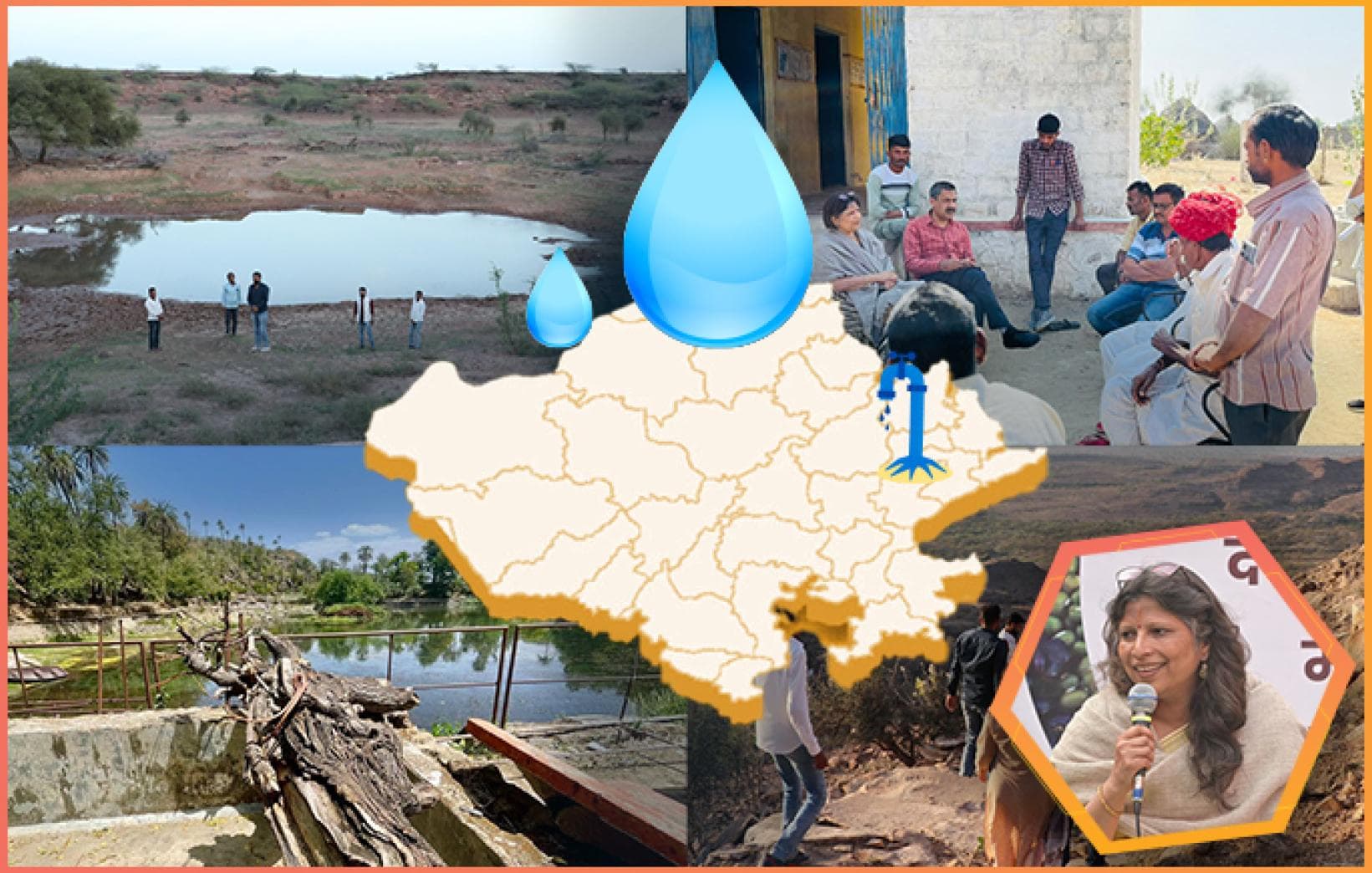
Rajasthan, India's westernmost state, encompasses Jaisalmer and Barmer, located along the Pakistan border, housing approximately 98 villages in the conserved desert national park (DNP) area. Notably, during the 1971 India-Pakistan war, residents from this area displayed exceptional valour and contributed significantly to India's victory. Following displacement from Khokhrapar, Pakistan, a larger chunk of the population migrated to India and here the government allocated them land to support their families. The region boasts cumin fields along Ramsar and Gadra roads and supports livestock like camels, goats, and cows. Villagers in surrounding areas emphasise the critical need for access to water, road, electricity, education and health services.
Despite enduring long struggles without basic amenities, recent governmental efforts have shown improvements. Access to essentials like power, electricity, and roads has notably been enhanced, alleviating some of the long-standing challenges in the region, but villagers in the national park area suffer because of several restrictions on developmental activities.
The villagers are open to change and propose transforming the area into a biosphere reserve or sanctuary, ensuring access to essential resources like water, electricity, and roads. Such a transformation could uplift the fate of the 98 villages in the region, connecting them with tourism, agriculture, and industry for sustainable development. Political dialogue between state and central governments is crucial to address these issues and chart a path forward for the region's holistic development.
In 2019, after a discussion on building up some campaign around urgent issues with the Sh Hitesh Shankar, editor of a popular national weekly Panchjanya, the Water Campaign, also known as "Jal Aandolan" was launched with a simple yet profound goal to address water scarcity through community-driven initiatives and solutions. Our approach was clear - to understand the depth of the crisis and find practical solutions by connecting with the right people and organisations, both governmental and non-governmental. It was a combination of editorial writing and ground action, as part of my core philosophy.
This mission led to the inception of ‘Dharatal’ in 2023, a platform committed to increasing awareness on water and other rural challenges, advocating for policy reforms. While mainstream media frequently overlooks the issues confronting villages, Dharatal steps in to bridge those gaps and elevate awareness. Supported by a policy-oriented organisation, we began our journey to explore the root causes of the crisis and identify pathways to sustainable change.
Our efforts were guided by a commitment to amplifying the voices of grassroot communities and bridging the gap between local innovation and policy formulation. I sought out stories of communities that independently addressed water problems, leveraging their solutions, wisdom, and knowledge systems. These grassroot initiatives grew substantially over time, culminating in my receipt of the first National Media Award for water stories by Bharat Prakashan.
Travelling independently and without financial support, I ventured to remote communities to understand their challenges, amplify their voices, and forge connections with agencies capable of addressing their needs. One such instance occurred in Achalgarh, a secluded mountain village in Mount Abu, a tourist destination. In Achalgarh, local youth Bhura Ram showed me the dire water situation. There were only two water sources, both were contaminated and caused widespread skin diseases among villagers. Refusing to accept the villagers' plight, I reached out to the Indian Institute of Technology, Jodhpur (IIT). Inspired by their innovative water purification device, I proposed implementing their solution in Achalgarh and they promptly agreed to undertake the same under the “Unnat Bharat Mission”. Their team of researchers visited the village, consisting of 55 families, to assess feasibility and devise an appropriate strategy for implementation.
After installing the water filter in Achalgarh, the village saw significant improvement in its water quality within three to four months. Encouraged by this success, an active ward panch of the village Panchayat named Jamna and a farmer Kan Singh from neighbouring village Saalgaon raised similar issues. There I encountered young girls, who were forced to fetch water from community taps, their only water source. Moved by their plight, I encouraged the villagers to raise this issue during the upcoming assembly elections, urging them not to boycott the elections but to use their voting power to demand action on the long-pending pipeline project. Despite the IIT team's commitment to addressing the water crisis in the village., they were unable to physically visit the site again. Understanding their limitations, I facilitated communication between the villagers and the IIT team, providing necessary information and acting as a mediator. Recently, the team sent another water filter to the village, marking progress in resolving the water quality issue. Yet, I emphasise that while such interventions address immediate challenges, larger policy and political issues must also be tackled for lasting change. These persistent structural issues require sustained advocacy and action at the policy level to ensure comprehensive solutions to community problems.
Being a trustee of Nana Patekar’s foundation, the foundation and his son Malhar Patekar provided additional strength to address community needs. I emphasised the importance of sustainable solutions over short-term aid. Instead of relying solely on external agencies, I advocated for leveraging government programs and resources, ensuring community ownership and sustainability. Fortunately, the Unnat Bharat Abhiyan facilitated by IIT, presented an opportunity to collaborate at community level. Through this program, we were able to provide water filters to the two villages in Mount Abu and conduct training for potters in different villages for preparing water filters made by traditional methods combined with research outcomes. One village has already begun using the filters, while the other is set to start soon, underscoring the significance of government partnerships in effecting positive change at the grassroots level. Interaction with the knowledge pool of technology and skill institutions, also helps in advocating the right solutions matching with the national vision.
Villages are indeed the backbone of our economy and the true essence of our nation, Bharat. It's in the villages where we find the rich fabric of traditions, culture, and the warmth of its people. The simplicity, sweetness, and love that emanate from village communities are unparalleled and cannot be replicated in urban settings. I recently had a meeting in a village Nandiya Kalla, near Jodhpur, and the experience reaffirmed my belief in the importance of rural communities. Despite my initial plan to stay in Jodhpur, the villagers insisted that I stay with them, showcasing their deep sense of hospitality and belongingness. This affection and connection with rural life inspire me to continue focusing my efforts on addressing the challenges and needs of villages. Recently, I unveiled a new initiative called ‘Deshaj’ which was refined with the help of Sh Rajat Ray, Social change expert with experience of working with global institutions at top positions. The essence of ‘Deshaj’ lies in connecting individuals who possess a profound commitment to community development. It is a village consultancy program, based on ground intervention and backed by different experts. One such remarkable individual is Sh Chetram from Maharashtra, hailing from Baripada village. Over 30 years, he has dedicated himself to the upliftment of his area, a feat that recently earned him recognition from the Maharashtra Government. Notably, Mr Chetram has generously directed all his earnings towards the betterment of his village. In a recent meeting, Sh Chetram, accompanied by an esteemed health and nutrition specialist from London Dr Anami Gour and Sh Rahul Mahajan, media expert, joined this initiative. Their presence highlights the diverse expertise and commitment among participants. Many others from various fields have also pledged their support, offering their knowledge and resources to advance village development initiatives. We have identified more villages and some Wetlands also for conservation and have started building conversation with them.
Looking ahead, we are planning a series of physical meetings scheduled for June. Importantly, this collaborative effort is entirely voluntary and unfunded as yet. As the facilitator of this initiative, my role is to amplify voices and connect individuals who are eager to contribute their expertise towards the shared goal of uplifting our villages. Multiple villages in Rajasthan are doing amazing work. I often emphasise that there are close to 11, 283 panchayats in Rajasthan alone, each brimming with immense potential and resources. It's crucial to support these villages before they fall into the trap of becoming city-like. Maintaining the essence of village life is paramount for our survival and identity. Unfortunately, villages are facing challenges such as increased drug addiction, migration, mental health and misuse of technology.
Our focus now is to empower villages and integrate them into technological advancements. There's so much work to be done in this regard. We've initiated a task for every village - ‘commit to uplifting the next 20 villages alongside yours’. Recently, these villages pledged their support, demonstrating their willingness to uplift their neighbouring communities. We're cultivating social leadership, where villages take charge of their development. We approach them not as authorities but as facilitators, offering guidance and filling gaps where needed. The commitment is clear: no village progresses alone; they uplift each other.
During our selection process, we prioritise villages where communal harmony prevails. The ability to sit together, communicate, and collaborate is a significant indicator of development. In Rajasthan and other states, caste dynamics often play a critical role. However, we're shifting away from such divisions, emphasising that village identity supersedes caste affiliations.
We're fostering an environment where villagers recognise themselves not by their caste but by their village identity. It's a gradual process, but we're moving in the right direction. Our selection criteria emphasise villages where unity and cooperation prevail, ensuring collective progress for all. I hope that the collective experiences of individuals with 20-30 years of expertise in their respective fields, including my experience in media and focus on rural India, policies, grassroots and women's voices will contribute significantly. Many other dedicated individuals bring valuable experience to the table. We understand the systemic faults and the underlying fault lines, and we're committed to addressing them.
We've assembled a core team of 5-6 people, aiming to foster collaboration. Each campaign has its dedicated team, and I'm working towards building cohesion among them. In all my endeavours, I prioritise the inclusion of women's voices. Despite cultural barriers, I firmly believe in amplifying women's voices as they bring immense strength and insight to the table.
Through the ‘Jal Aandolan’, we aspire to catalyse a movement for change, one that transcends boundaries and empowers communities to take ownership of their water resources. Our journey is far from over, but with each step forward, we draw closer to realising our vision of India where every individual has access to clean and sustainable water sources.